|
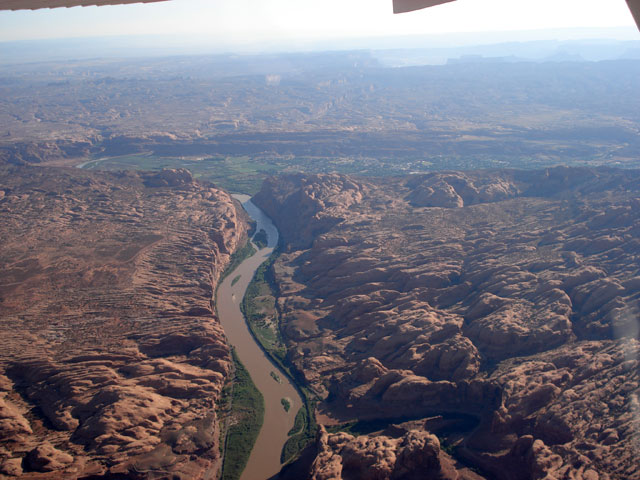
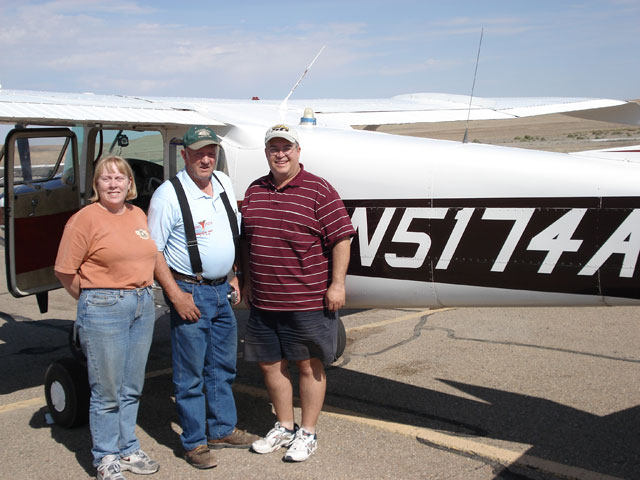
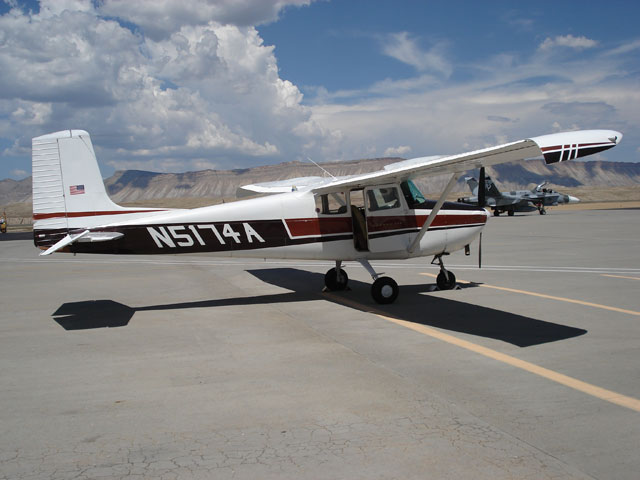
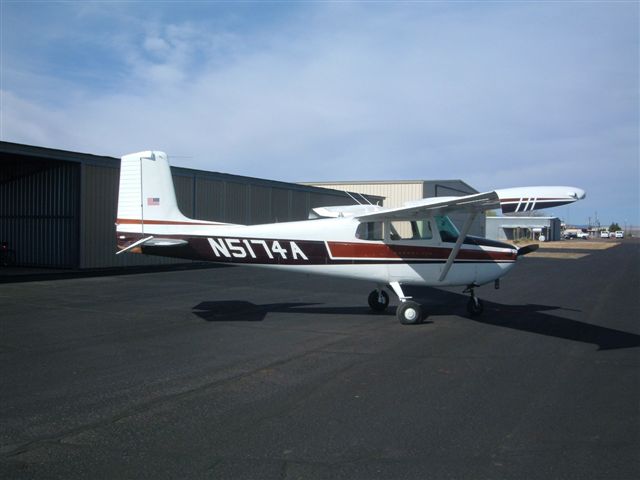
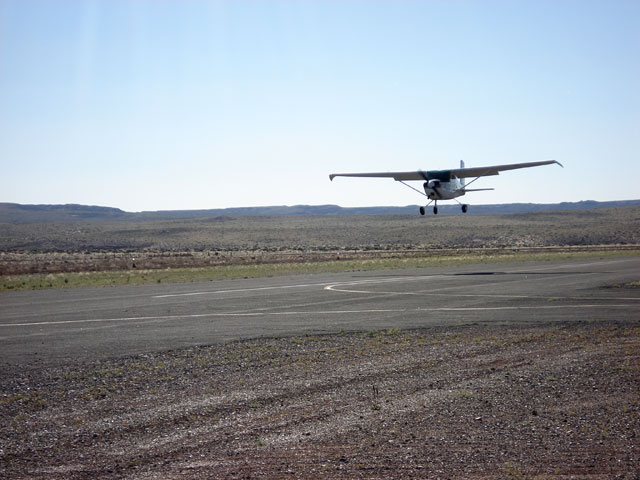
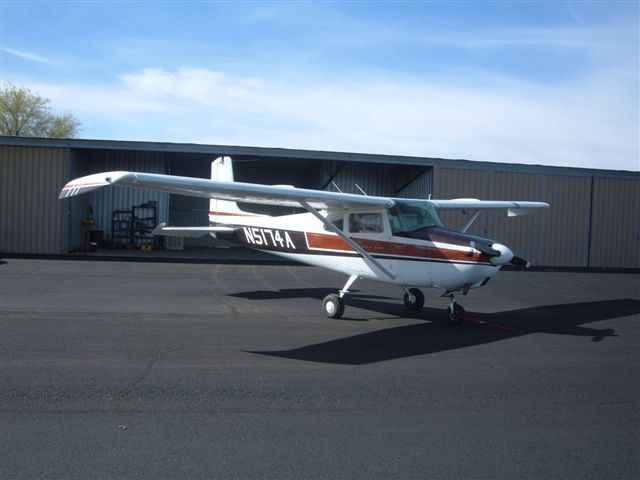
N5174A, a 1956 straight tail Cessna 172, is an interesting aicraft. Created during Cessna's very first year of 172 production (and there we about 40,000 more to follow), here's a piece of trivia. Cessna secured a continuous batch of N-numbers and thus, her tail number, N5174A, means she's the 174th Cessna 172 to roll off the production line. Here's another piece of trivia; her orignal owner bought her from the Cessna dealer by trading in his Stinson 108 and $5000 cash money. How do I know? Easy! It's because both Lynn and I learned to fly with his son whilst in Moab, UT during the summer of 2006. By the way, that's beautiful Moab, UT nestled in the valley just beyond the Gateway Formation (with the Colorado River in the foreground).
While N5174A's orignal owner is deceased, his son Lavar Wells is a mountain-flying instructor who took us under wing almost as soon as he heard the tail number not only because he'd accompanied his Dad to buy her, but because he had done a lot of his own flight learning in her! Naturally enough, he immediately recognized the N-number upon my mentioning it on the telephone - small world, eh? By the way, his Dad was known as the "Fying Bishop" because he used N5174A in Utah - both for the fun of flying - and to minister to his rather widespread flock. And Bishop Wells took ministering in a literal sense because he occasionally used N5174A as a makeshift air ambulance (when the need arose) because the community they lived in was far, far away from any hospital!
Anyway, over the years N5174A has been lovingly modified in many ways to make her into rather more than her designers perhaps ever envisioned. She's the direct result of the care and attention of her owners and thus, she's evolved into a rather nifty little bird. The modification which makes the most immediate impression on folks is on the thrust side of the equation. That's because the anemic Continental O-300 (145 horsepower) was soon ditched (1961) in favor of a robust Lycoming O-360 (180 hp). The extra 35 ponies don't sound like much but believe me it makes a "huge" difference in how the aircraft performs! Interestingly enough, the STC for the O-360 modification, which cost big money (about $6000 in 1961), still costs big money in the 21st century (approximately $30,000) and that's before the constant speed prop! Speaking of which, the extra power is harnessed by a McCauley 78" constant speed prop vs. a fixed pitch prop. Thus, you get the best of both worlds, a fine pitch to climb like crazy (over 1000 fpm when lightly loaded) and a coarse pitch prop to cruise fast and economically (as opposed to the compromise you get with a fixed pitch prop). In case you didn't know it, this is a prop more typically fitted to a high performance craft like a Mooney! As a result of the Lycoming/McCauley combination, she climbs like a homesick angel while gaining the ability to loaf along at 125 mph at 75% power while sipping a mere 7.6 gph.
Overall, the engine/prop modification rates as a very satisfactory upgrade! However, if it were only for the added climb performance and cruise speed, the extra power and the complication of the constant speed prop might not be that big a deal. Where the extra power and the value of the CS speed prop really come into play is when she's low and slow (i.e. on the back side of the power curve) when you can go really, really slowly because there's plenty of power on tap! Anyway, while the airframe has about 3600 hours total time, her engine presently has 1600 hours (both increasing since we exercise her regularly) and for what it's worth, this engine time isn't since 1961 because she was fitted with a brand spanking new O-360A1A in 1977. This engine, by the way, consumes a quart of Aeroshell 100 every 9 hours (give or take), has compression in the mid to upper 70s, and runs like a top!
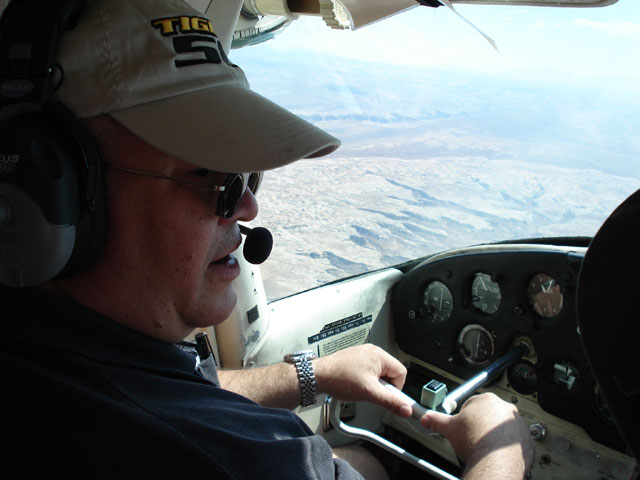
Surprising to pilots who have only experienced newer 172s, The straight-tail 172s like N5174A have greater rudder authority and can slip rather easily. In addition they're equipped with 40° of flaps controlled via a Johnson bar - much like the hand-style parking brake found on sports cars. Newer 172 models, of course, only have 30° of flaps, which are controlled electrically. As a result, short field landings in N5174A are really easy - and short field take offs are a doodle because the proficient pilot is rewarded by the versatility of leaving flaps retracted until some speed is built up (with the resulting lower drag profile) before quickly "dropping" in a notch of flaps . . . something you could never do with the slow-to-deploy electric flaps! And don't forget the extra notch of flap can really come in handy during steep descents over an obstacle!
Another plus (once you're safely back to terra firma) are the nifty Cleveland brakes. These feature dual-piston calipers and can smartly slow you down as compared to the original Goodyear (single-piston calipers) units - all in all, they're a rather nice little mod! Yet another nice mod involves the the wings of N5174A, which have been worked over a little as well. These mods, in particular, were undertaken primarily for the enhancement of the flight envelope and include a Bush Conversions STOL (Short Take Offs and Landings) kit. These are the leading edge cuffs and the stall fence - look closely just above where the wing struts join the wing and you'll see them. These make for fabulous slow flight handling. But that's not all because she's also equipped with a set of Super Tips. These, especially, add to her "purposeful looks" but pay off handsomely with a slightly higher cruise speed. Hence, any way you look at her, N5174A, or Li'l Bit as we call her, is a cocky little airplane with looks that scream, "Let's go fly!"
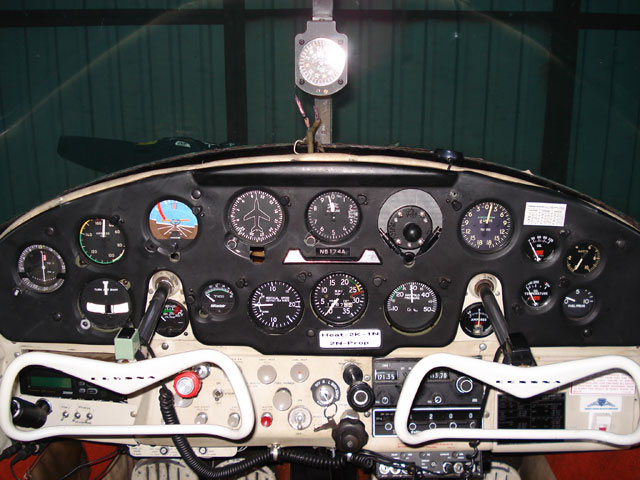
N5174A is essentially a VFR aircraft because though she has a heated pitot tube, her KX170B NAV/COM doesn't have a glide slope indicator installed. There is also a panel mounted GPS, a II Morrow Flybuddy 820, as well as a hand held GPS, which mounts on the blank instrument plate just to the left of the G-Meter (like that's really needed) using a RAM Mount. Along the way, several other little things have been done for her, like adding an engine driven vacuum pump, a Mode C transponder, and a strobe to make her easier to see in the air.
Finally, while her paint is a little on the old side (the usual chips you would expect), she still takes a nice shine. Also, though her interior is rather dated, nothing is torn and hence, everything remains serviceable. Plus, because she's lived in ID, UT, MT, and NM her whole life (her present home is a hangar in central FL) she's as corrosion free an example of Cessna's "Toyota Corolla of the air" as you'll ever find.
What's in store for in the future for this jaunty little bird? Perhaps a switch to conventional landing gear (thereby turning her into a baby 180), or maybe even a float kit, and who knows, perhaps the addition of some basic IFR instruments and certification. But the fact is this is all speculation because I'm just her current caretaker . . . and she's a joy just as she is now!
|